brief
During the fall of 2019, I was enrolled in Georgetown University’s Design Bootcamp course. Over the course of 16 weeks, my classmates and I completed many individual assignments that contributed towards a singular and larger case study. This is that case study. The brand I chose to focus on was Nike.
brand. identity. UX guidelines.
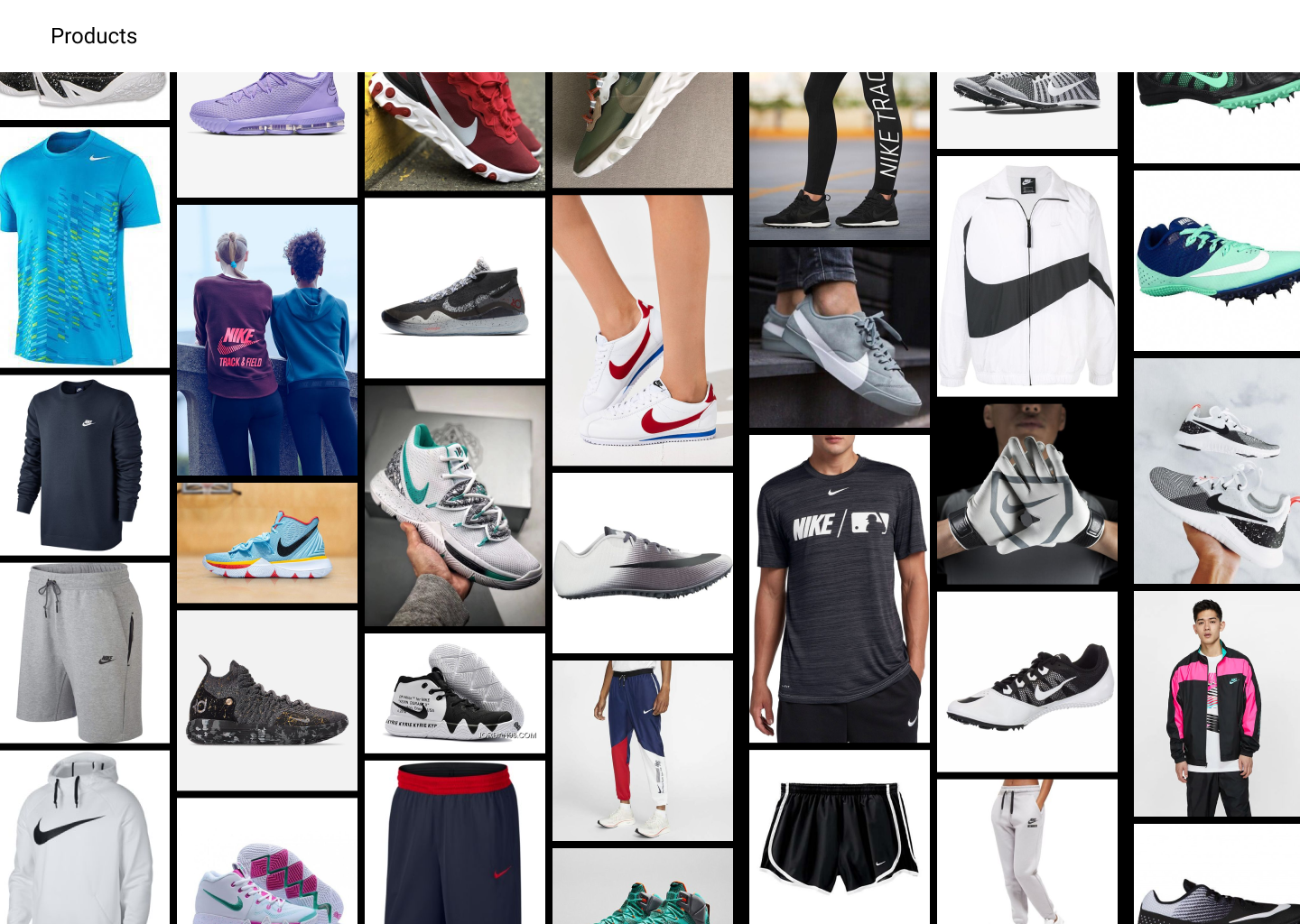
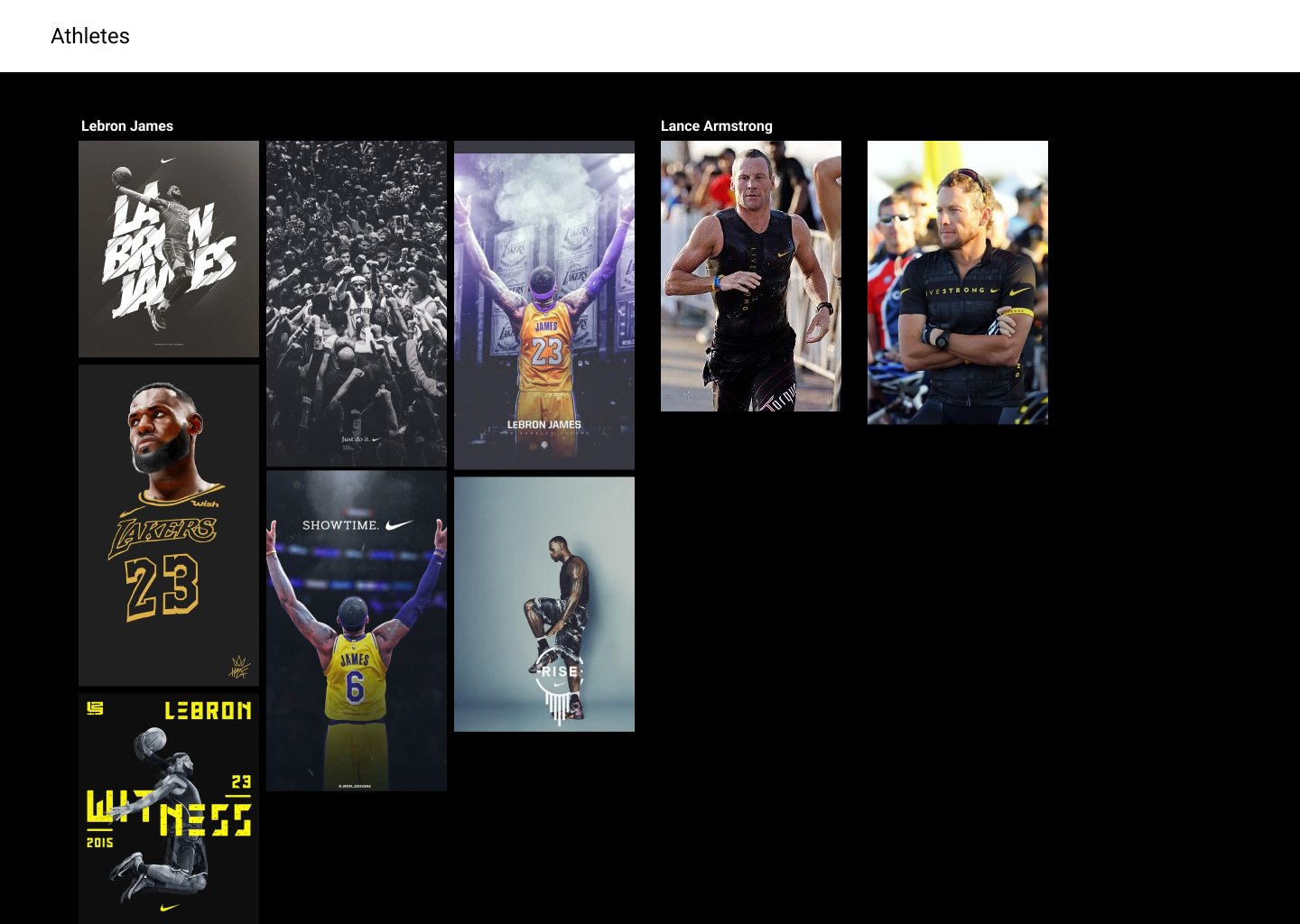
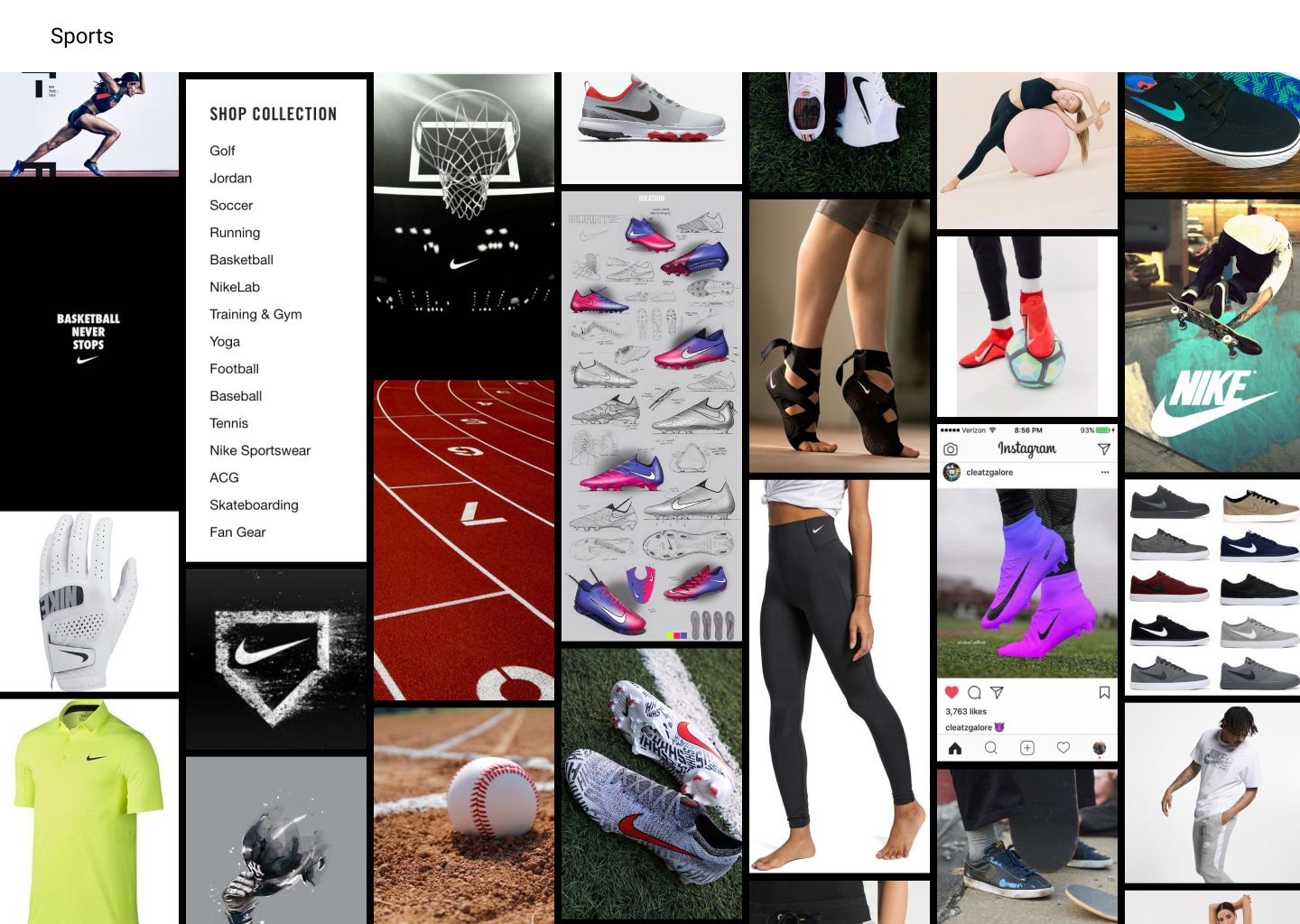
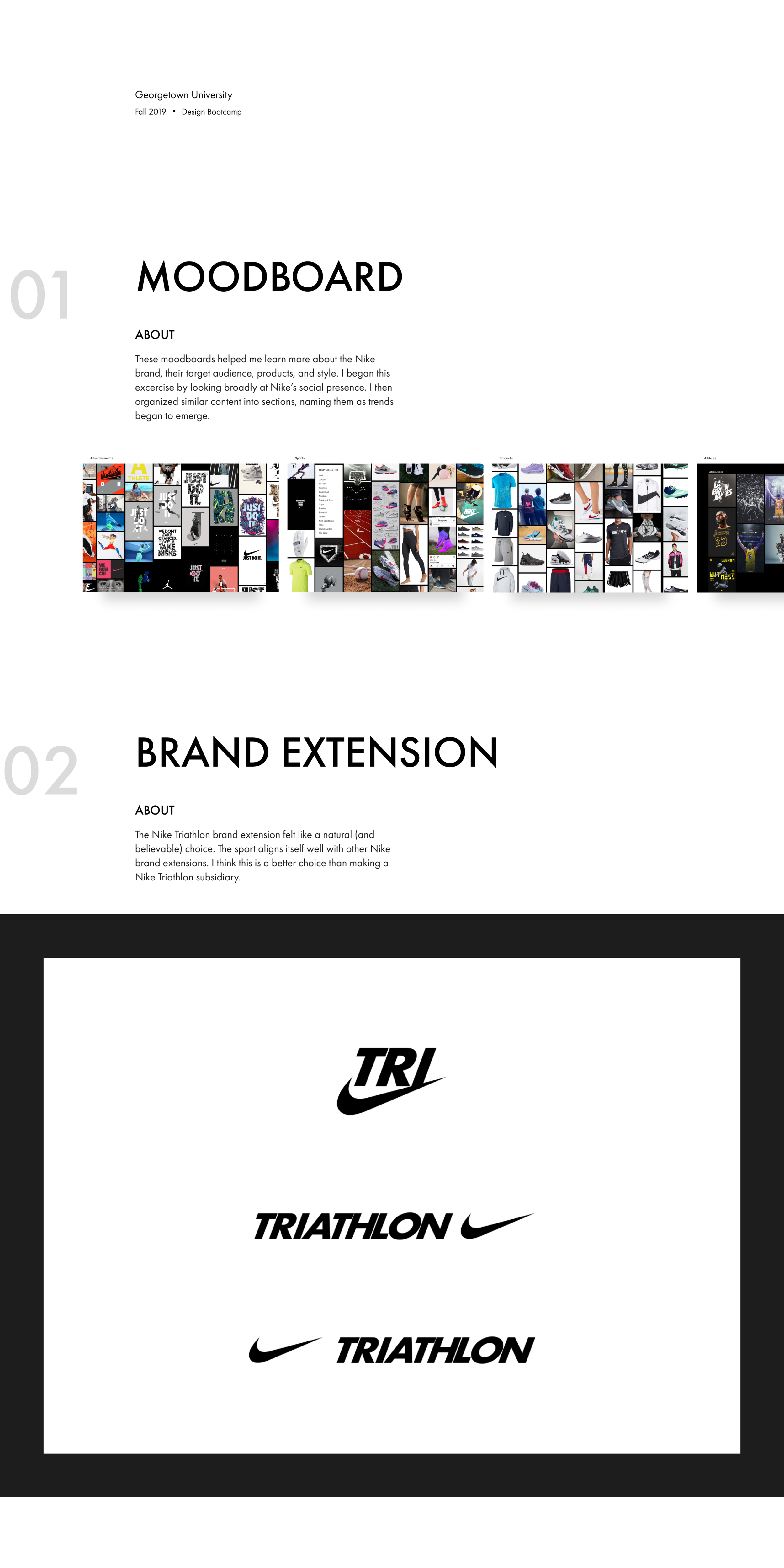
I began this project by doing market research on Nike. I sought to understand who their target audience, brand strategy, product space, future goals, and more. While conducting this research, I created mood boards in Pinterest and Figma to document what I was finding. As trends began to appear, I grouped similar content together and assigned titles. One of the module’s assignments that helped guide this work was to document Nike’s target audience. The topics I chose to pursue as part of this packet were as follows:
Strategy and focus
Target demographic
Sports idols
Marketing and geographic variables
Extensions and subsidiaries
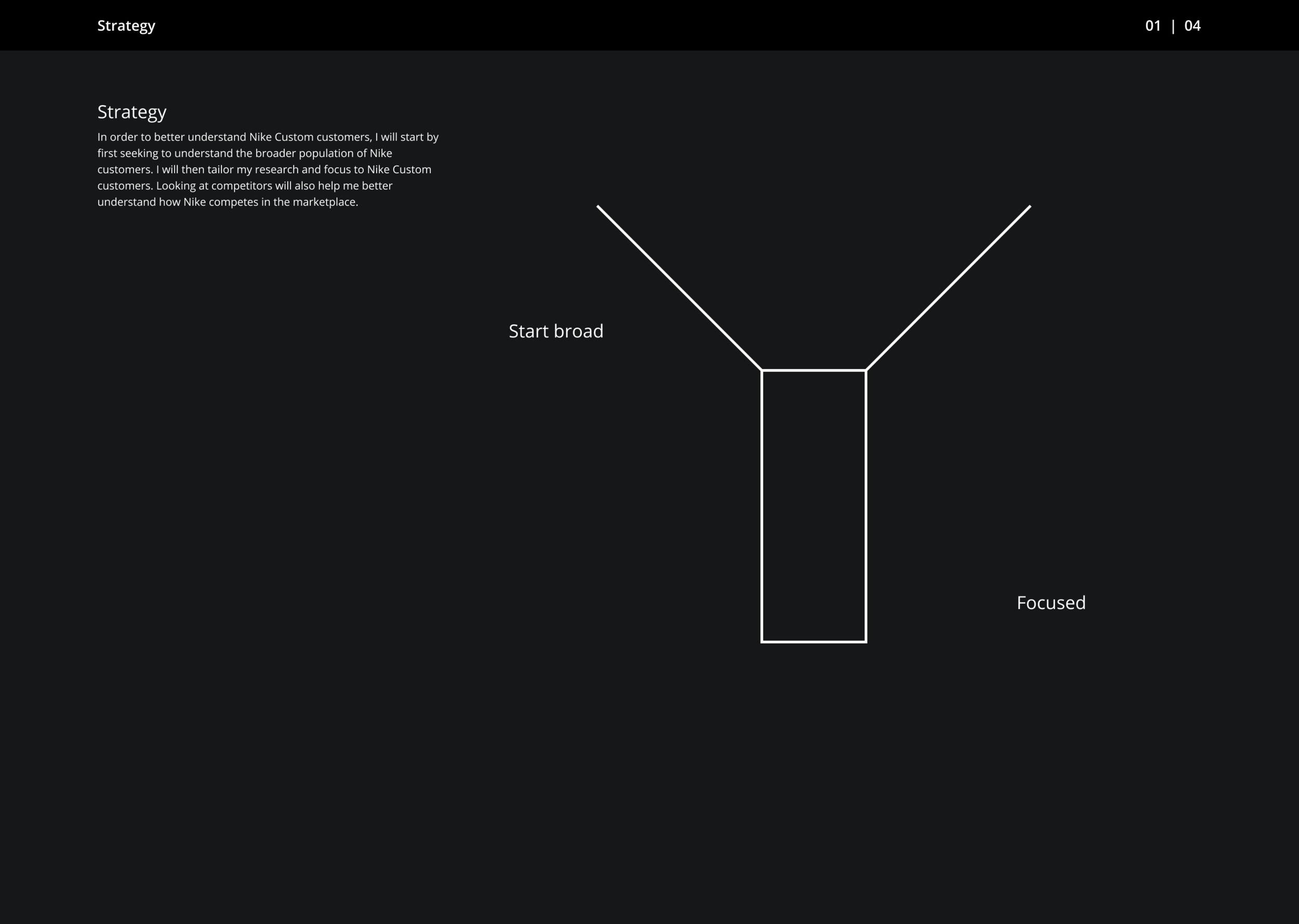
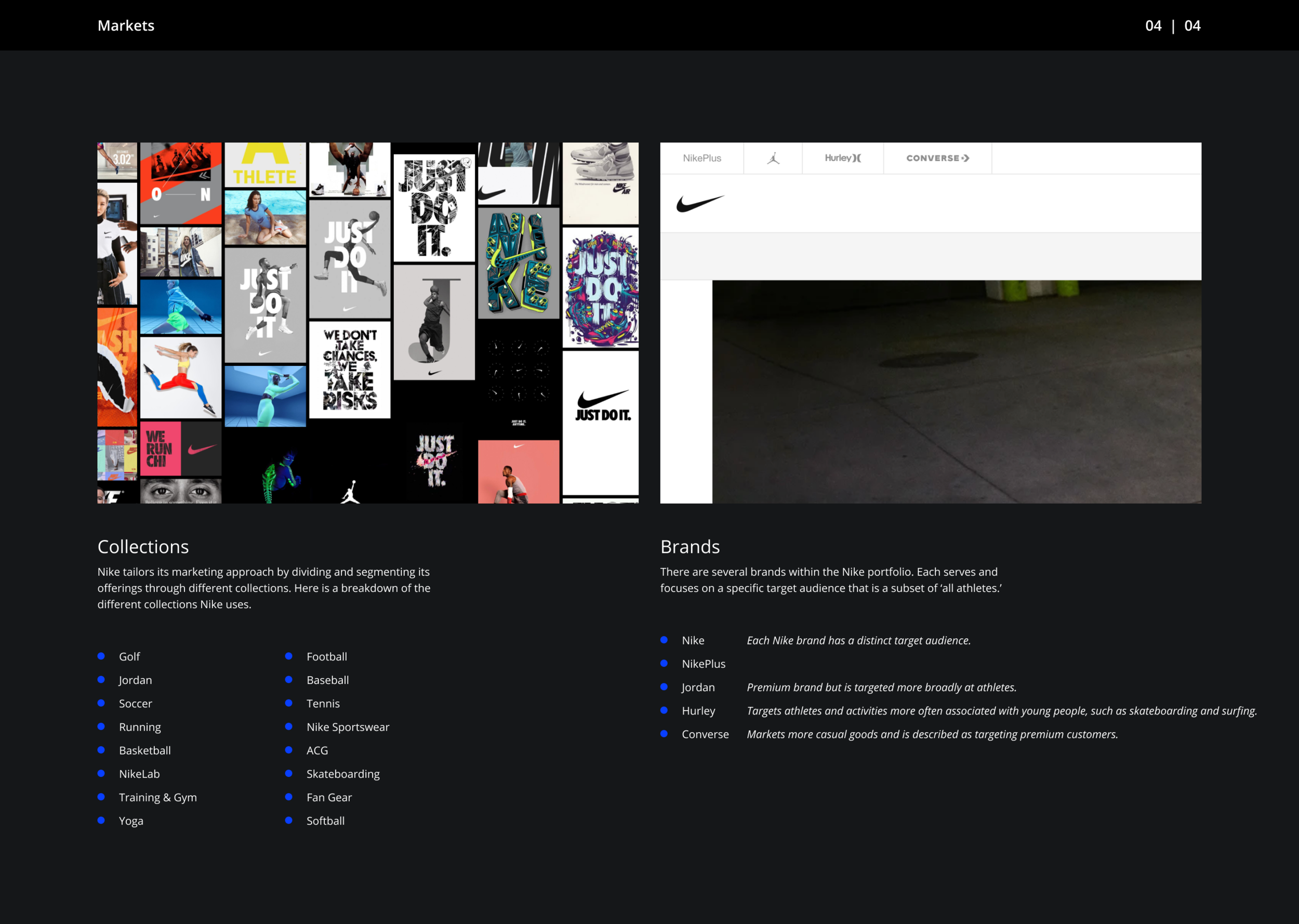
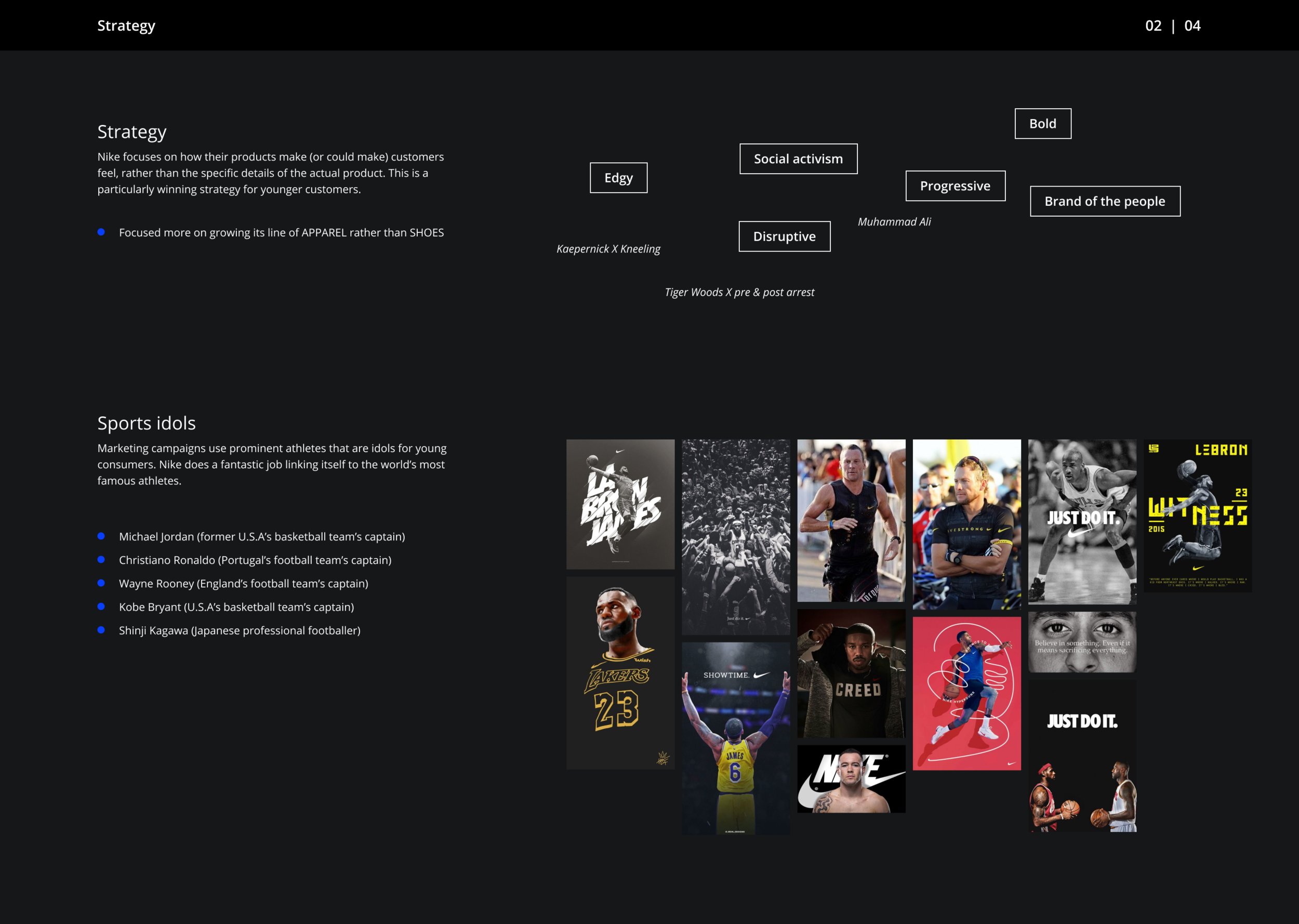
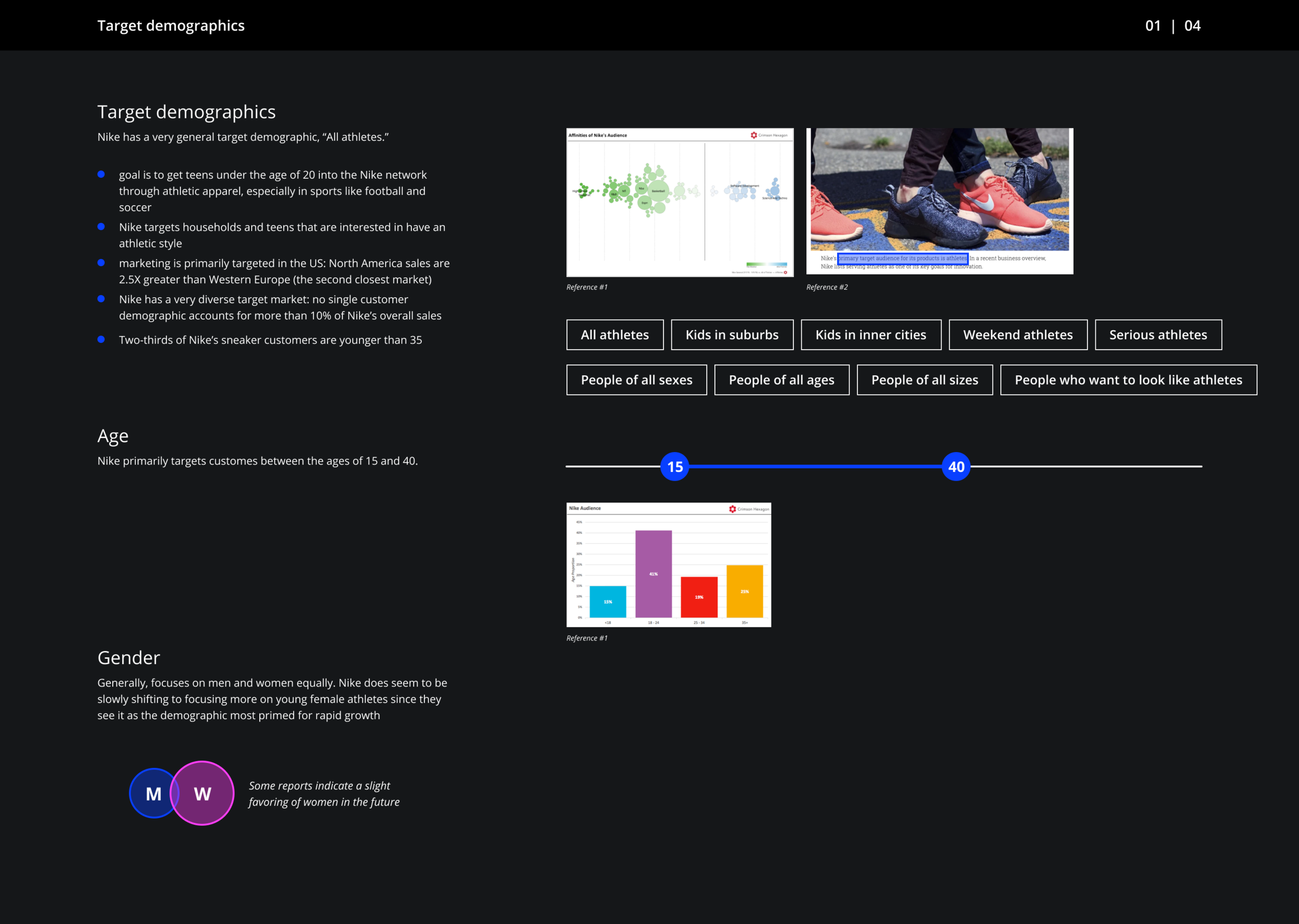
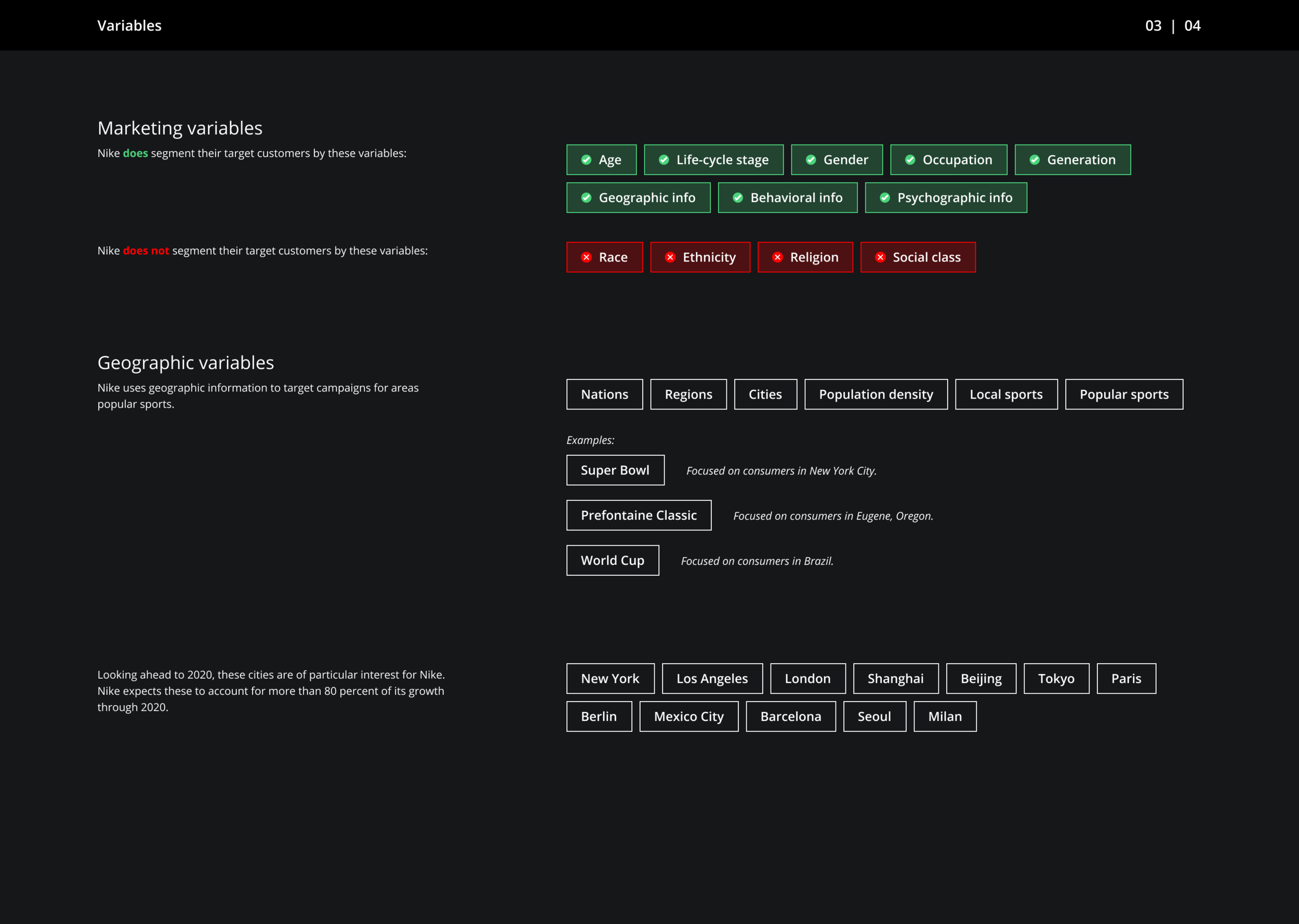
My research started very broadly. I began with general Google searches to see what results came up on the topic. I chose to explore a handful of links from each search. Some were helpful while others were interesting but didn't really help me better understand Nike's target audience or their own approach in defining it. Ultimately, this research helped me better understand the general target audience Nike focuses on. I followed these Google searches by looking at Nike's profiles on Twitter, Instagram, and YouTube. I was curious about how they balanced selling their products with engaging with customers and followers.
If I had access to Nike's decision-makers, I would ask questions to better understand their approach to marketing and branding. Questions like the following:
Who is Nike's target audience?
Does this audience change by product, category, or collection? If so, how? (I'm assuming Nike's marketing technique changes drastically from product area to product area. I'm sure there is overlap between sports and product categories and I would like to better understand how they pinpoint and understand this audience.)
What is the typical age and gender of Nike customers? How does this data change across collections?
How does Nike currently expand their brand reach and acquire more customers?
Who are Nike's largest competitors?
What tools does Nike use to engage with their audience? Which are most helpful in expanding the overall audience count?
What tools does Nike use to understand their audience habits, emotions, buying habits, etc.?
How does Nike segment their market?
What are Nike's demographics?
Please describe the average Nike customer.
Do you have target personas? How were these personas defined?
Search sample:
Nike target audience
Nike customers
Nike audience
Nike potential customers
Nike brand segmentation
Nike brand outreach
Nike brand strategy
Nike customer breakdown
Nike customer details
Nike branding strategy
Nike brand loyalists
Brand extension
I chose to explore a new product line for Nike: triathlon. Currently, Nike does not sell shoes or clothing for triathletes or endurance athletes (aside from running). I find this kind of odd, considering the growth of the sport and the fact that some of Nike's competitors have begun entering the market.
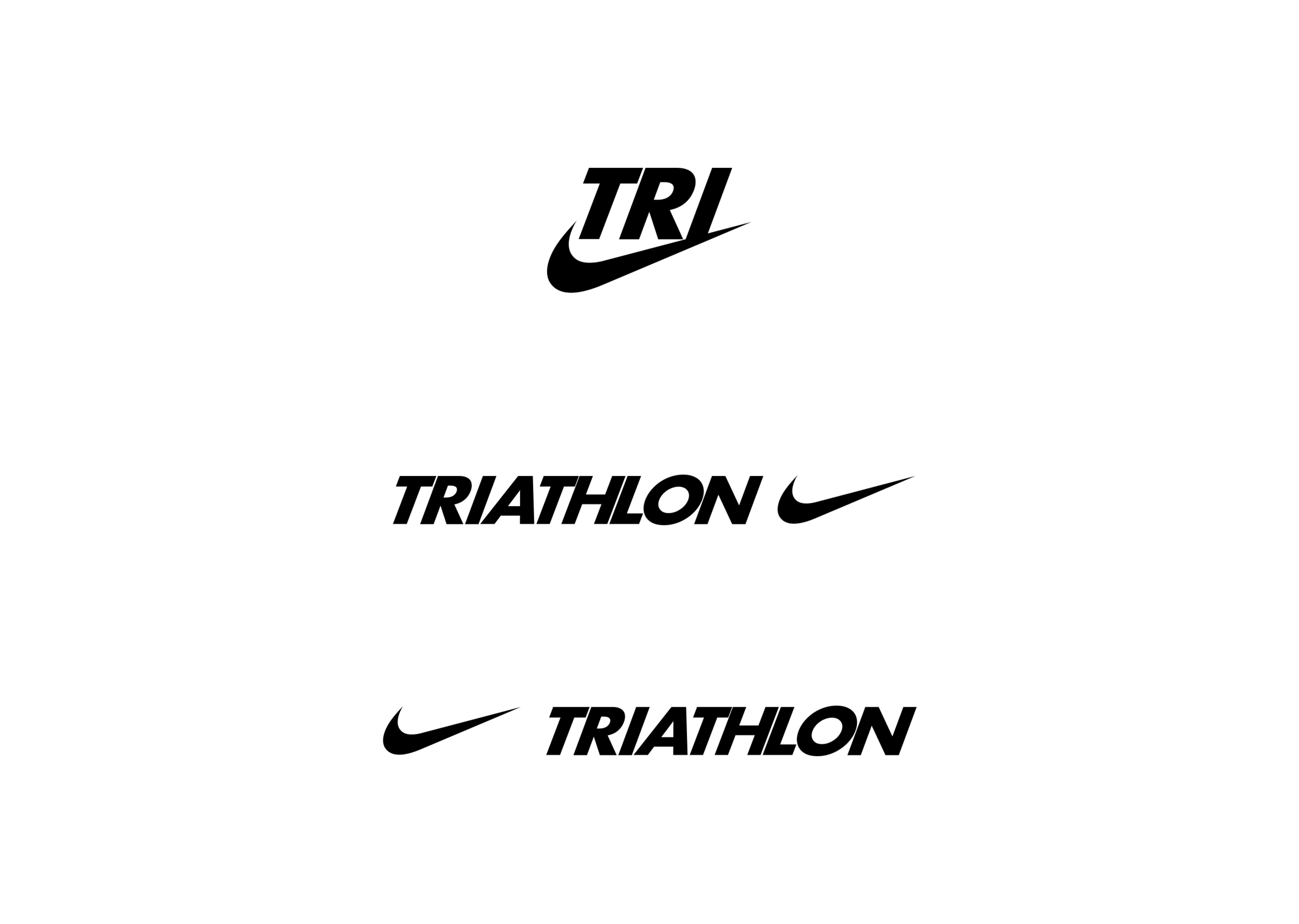
After spending time researching the sub-brands and extensions within the greater Nike family, I chose to treat this new product line as a Nike extension. Other Nike extensions are:
Nike Skateboard
Nike Golf
Nike Plus
In each of the examples above, the product line keeps a clear tie to the Nike branding. Since I was focusing on 'triathlon' being a new extension, I chose to follow with a similar approach.
brand guidelines
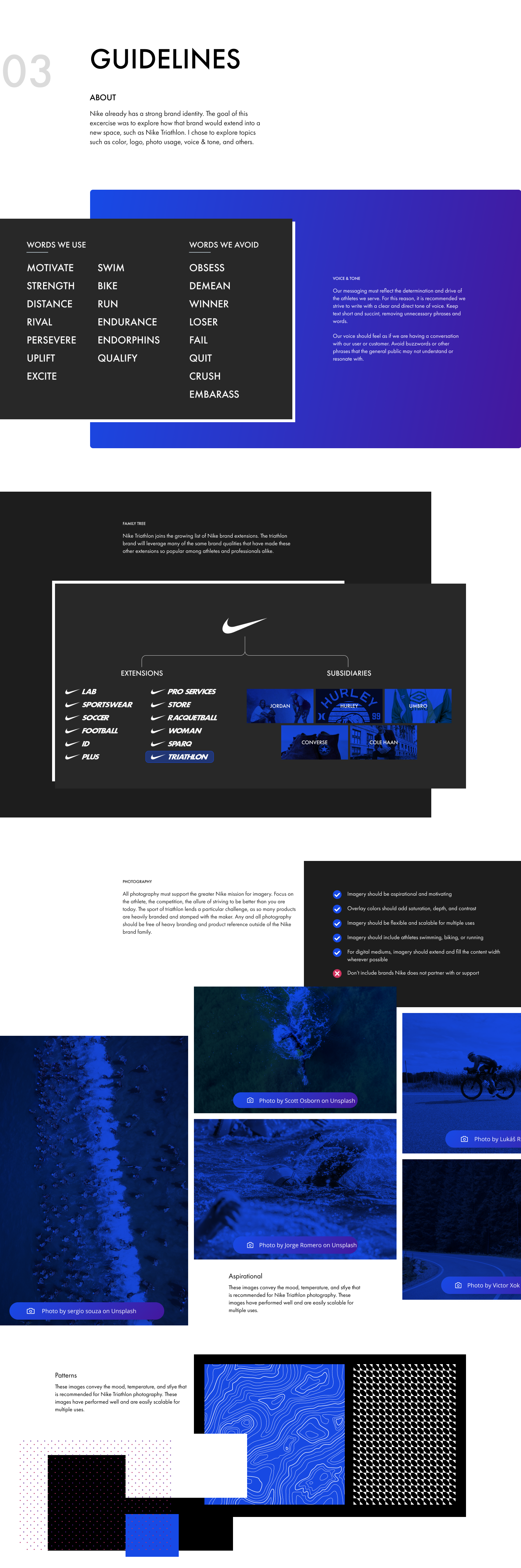
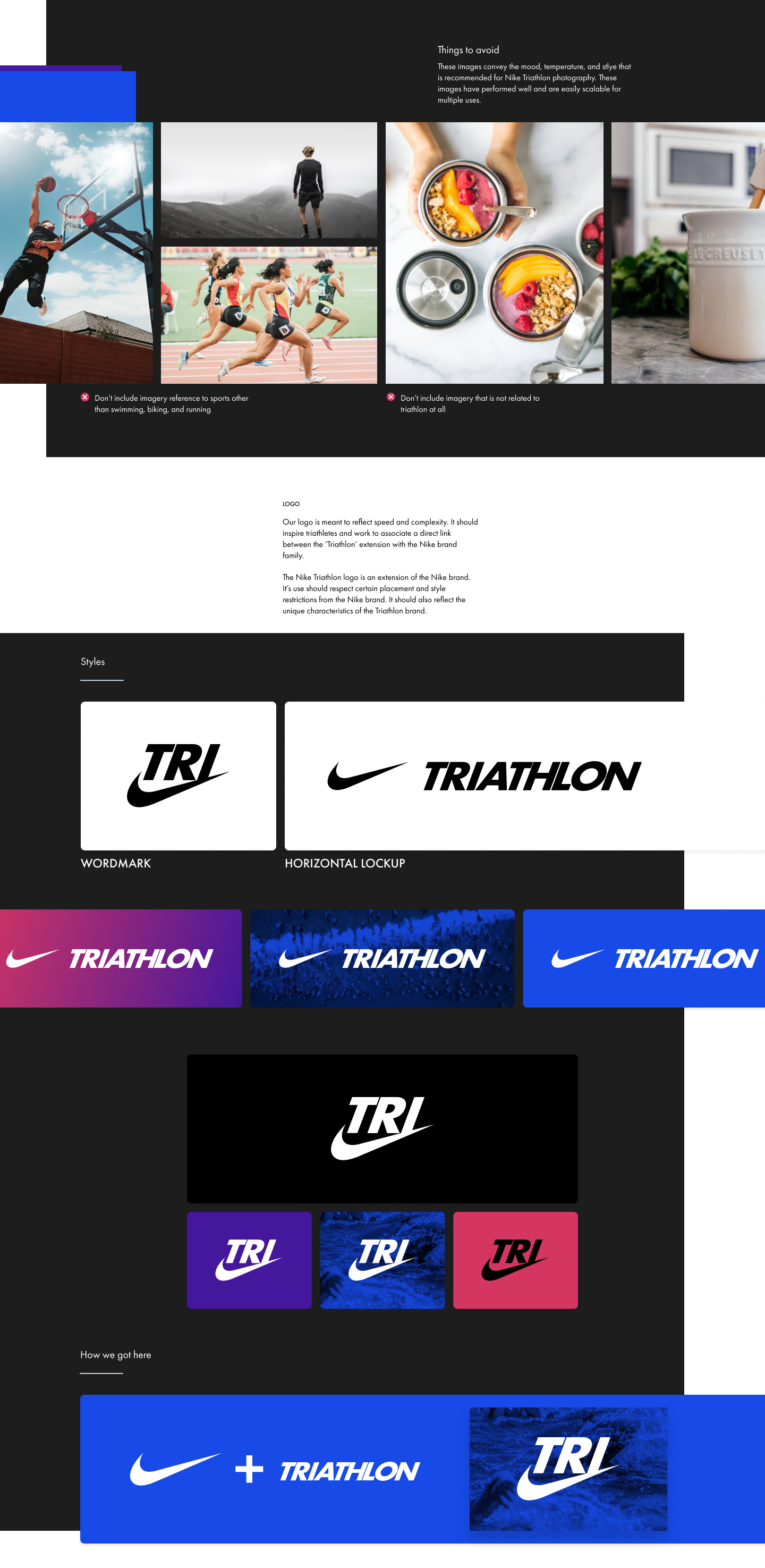
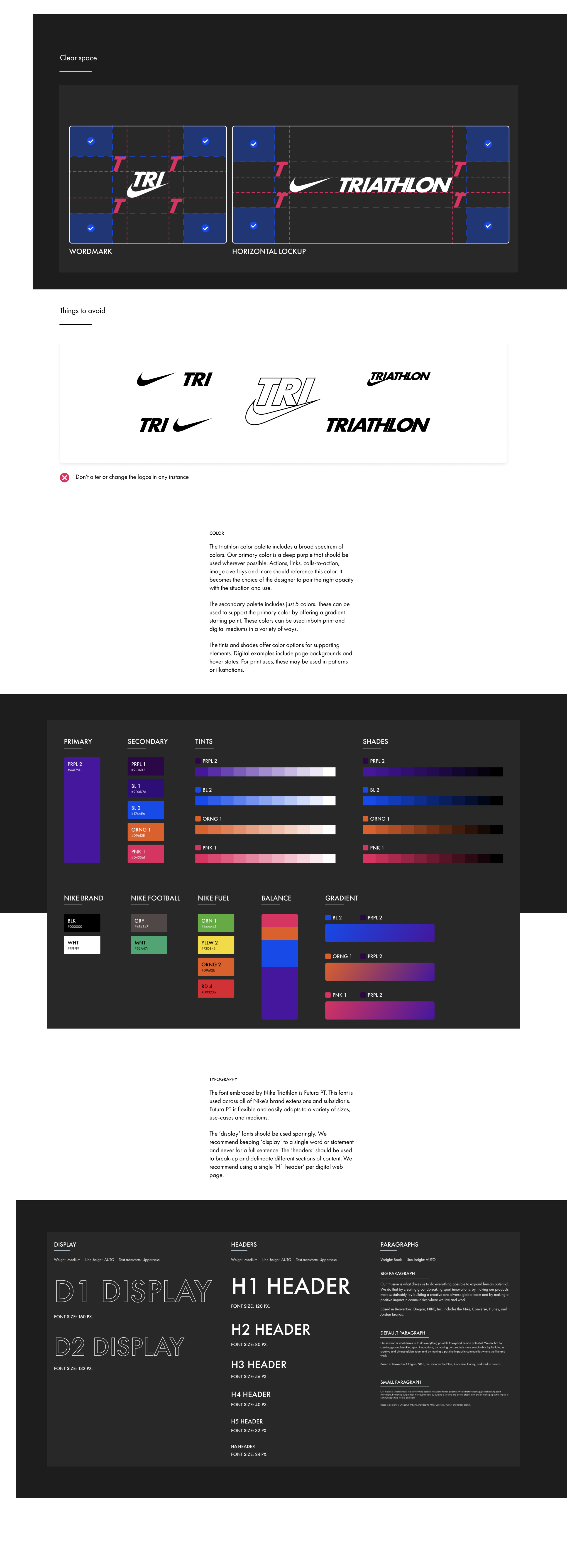
The next step was to create brand guidelines for the Nike Triathlon brand extension. Returning to the research I initially conducted, I was reminded that Nike doesn't publish much of their brand resources so I chose to look to their marketing pages for inspiration.
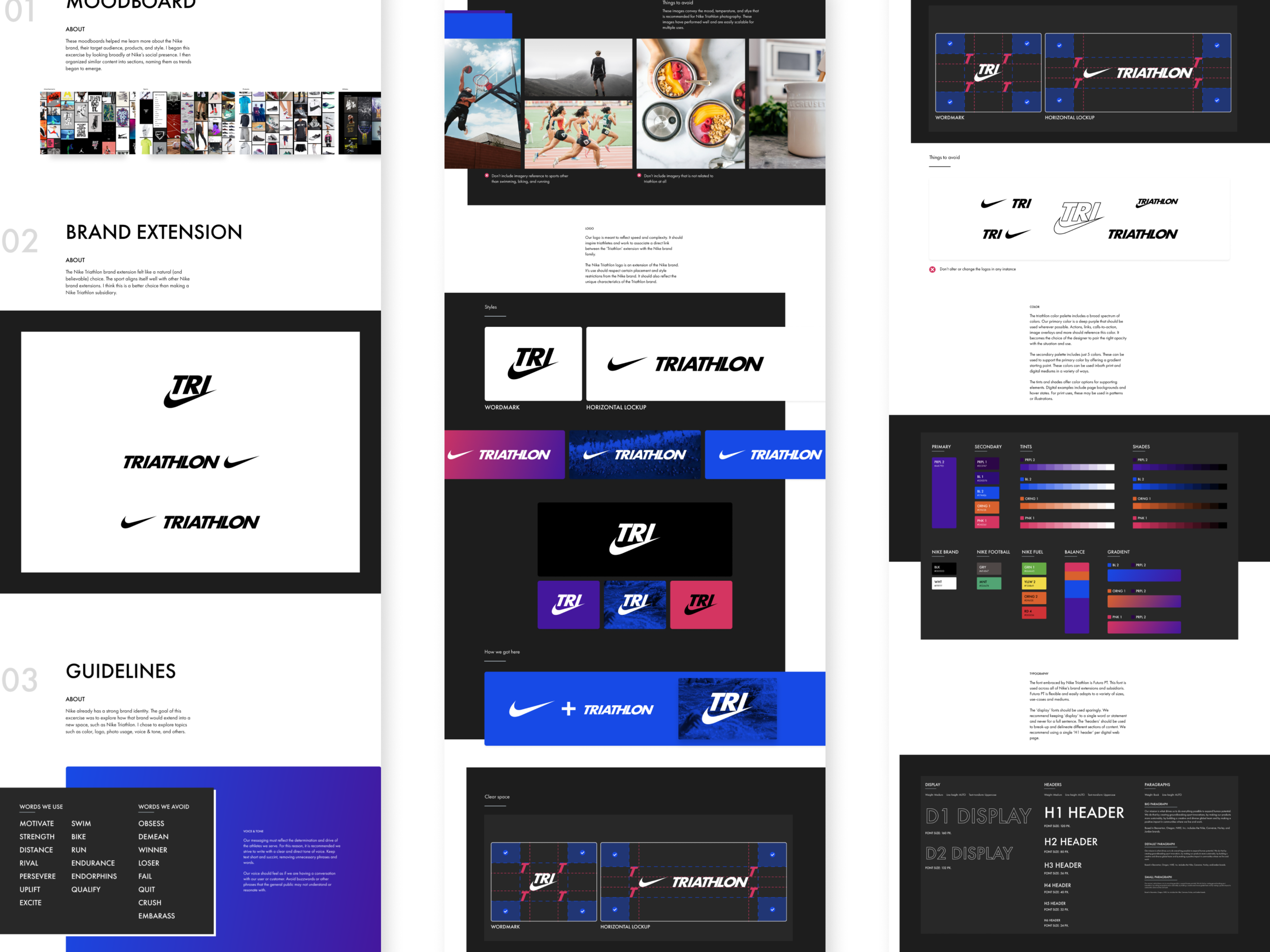
Working on the brand guidelines was an excellent opportunity to really dive into the details of how Nike Triathlon would be marketed and branded. I focused on:
Voice & tone
Photography
Logo
Color
Typography
Within each section, I defined proper usage for each UI element. Most of these guidelines outlined topics that would only apply to digital branding.
storyboard
Once I had defined the brand guidelines, I set to work on creating wireframes. I began by first defining a storyboard to work against. I came up with a persona named Chloe, who is a young athlete new to triathlon.
The scenario below shows her interacting with the app and selecting a race from a list of upcoming triathlons. Once there, the app suggests products to buy that would help her during the race. Ideally, we would have data on both the user and each race so we could make informed suggestions about which products would help athletes at different levels compete at different distances.
booth design
The next module’s assignment covered booth design. When considering what aspects of a Nike Triathlon expo booth would make the most sense, I tried to consider three main topics:
What current triathlon vendors do when showcasing products via booths
What/how Nike presents their booths
What/how Nike brand extensions present their booths
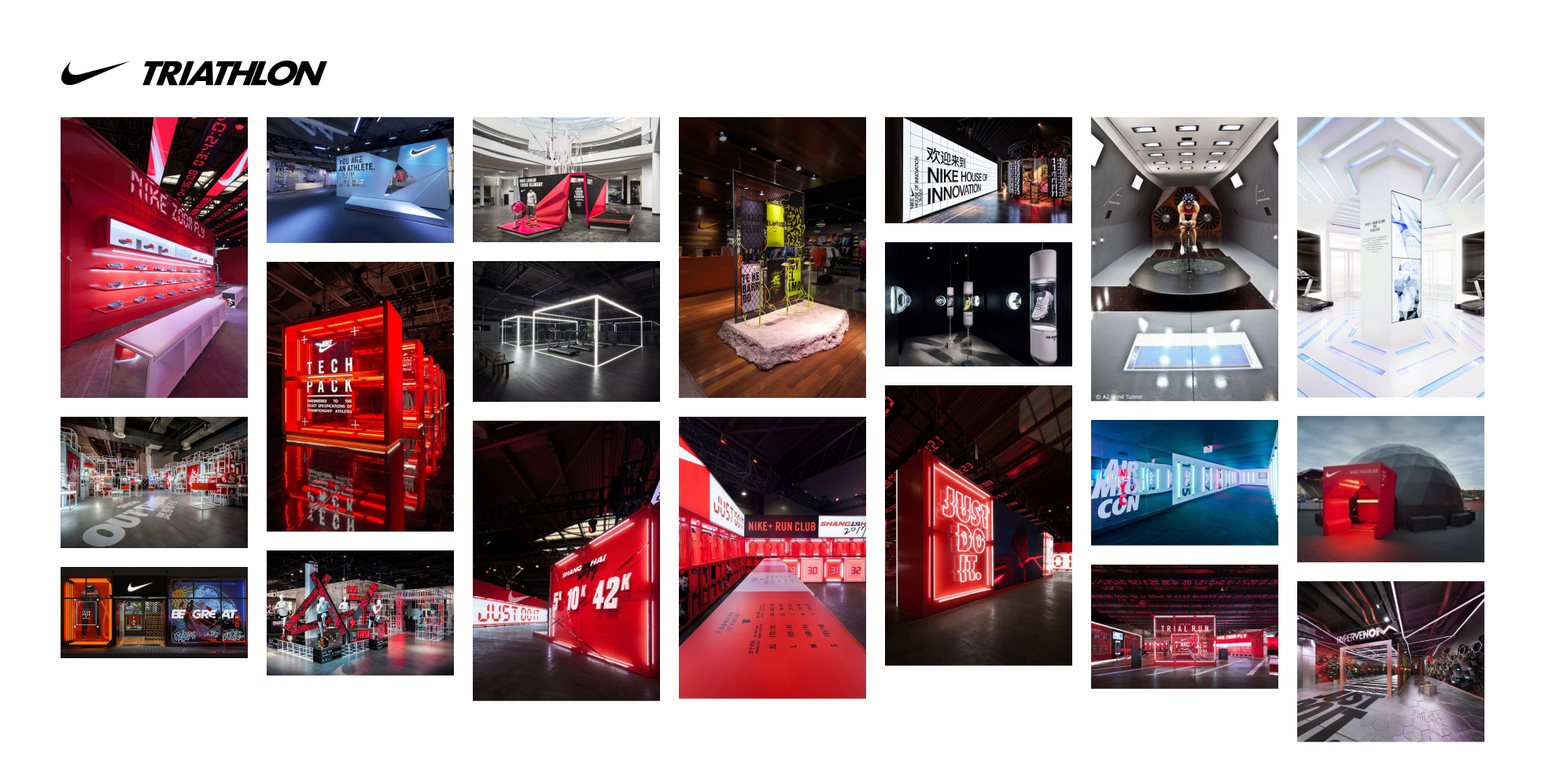
Nike is a company that makes a huge impact when it showcases their products. Often times, their booths show up at race expositions rather than large-scale retail shows. Part of this ties back to the way Nike does their marketing. They would rather be an aspirational brand than a heavy-handed company pushing products. They obviously do sell products and push them to consumers, but they do so in a way that is more subtle. Designing a trade booth for Nike Triathlon would have to consider this and align to it, so as not to break from the existing Nike brand style.
Goal
The goal of any Nike Triathlon booth would be to inspire athletes and help them learn more about which products will help them specifically compete in triathlon. Nike is a global name with a certain expectation of excellence. The booth would have to reflect that brand name and present everything in a unique, larger-than-life style. The focus would be on competing and the sport of triathlon. The booth would need to feel like Nike and be seen from across any trade show. As athletes/visitors get closer, they begin to see the phrasing and imagery that tells them this is the triathlon extension of Nike. Products would be presented similar to their current showrooms, with hero products taking more room and garnering more attention.
Experience
Immersive, large-scale booth
Display font paired with huge images of triathletes competing
There would be support text, but mostly to tell a story rather than promote a product
Products would be there for consumers to see and interact with. Near each product would be information regarding price, availability, and which triathlon distance it is best suited for
Perhaps house the entire booth in a wind-tunnel, with product videos being shown and the data behind how much of a difference Nike Triathlon products make for different skill levels of athletes
Ambient design
When thinking about what ambient marketing concepts made the most sense for Nike Triathlon, I tried to keep a few things in mind. I wanted to make the most of what little time an installation might have with a consumer in the real world. To make this work, I looked for interactions within triathlons that are easily recognizable by athletes. I also knew that whatever concept I came up with would have to integrate seamlessly within the Nike brand, which meant bold and aspirational messaging. The two concepts I created are:
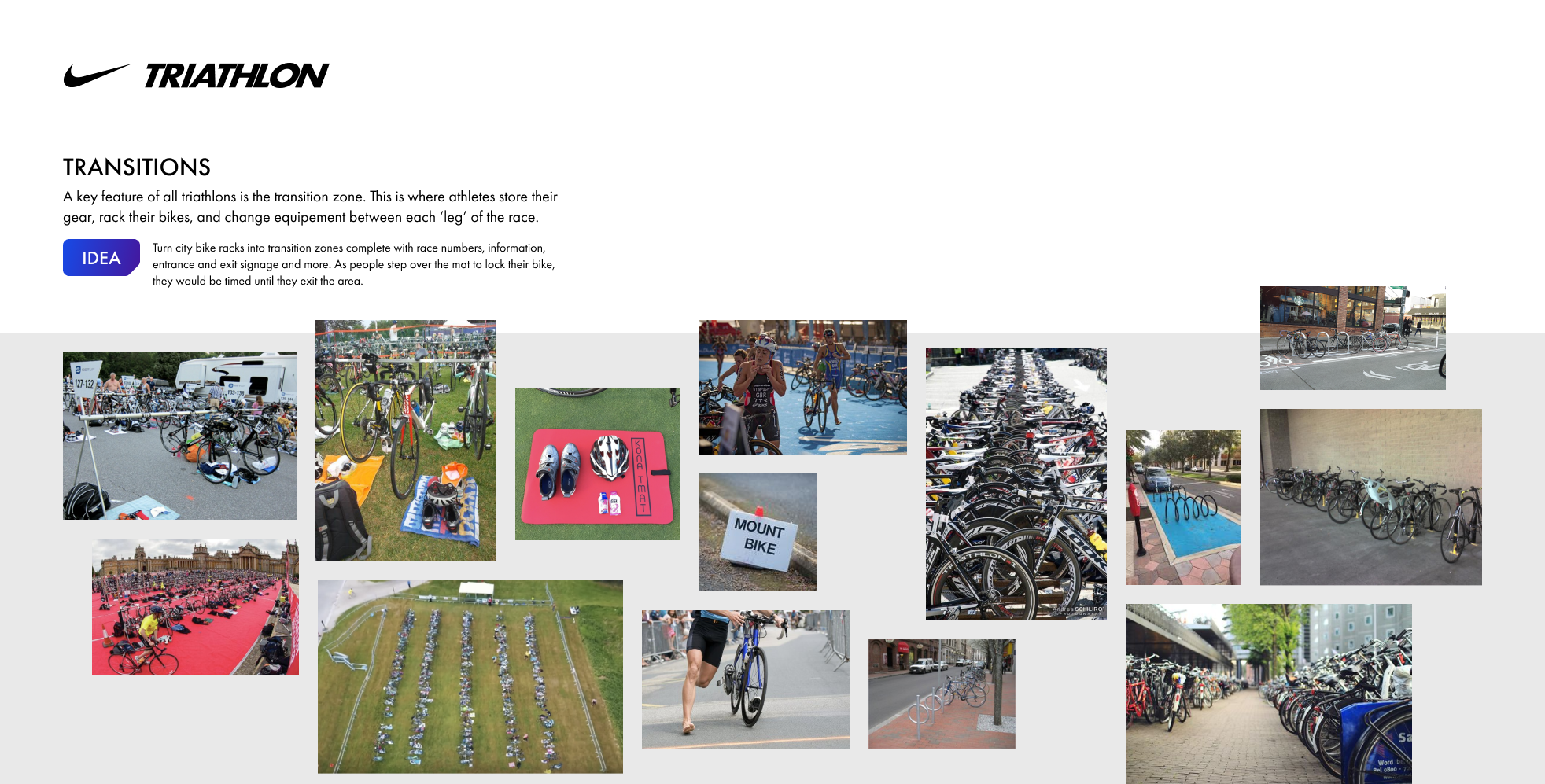
Triathlon transitions. The idea here would be to turn city bike racks into transition areas. Transitions are part of every triathlon, regardless of the distance. The basic concept is to have a central place to store athletes' equipment and offer an area to transition from one sport to the next. For the Nike Triathlon transition, I envision an interactive installation with bold wayfinding and signage. Volunteers could distribute takeaways and people could learn more about the brand extension while they rack their bike.
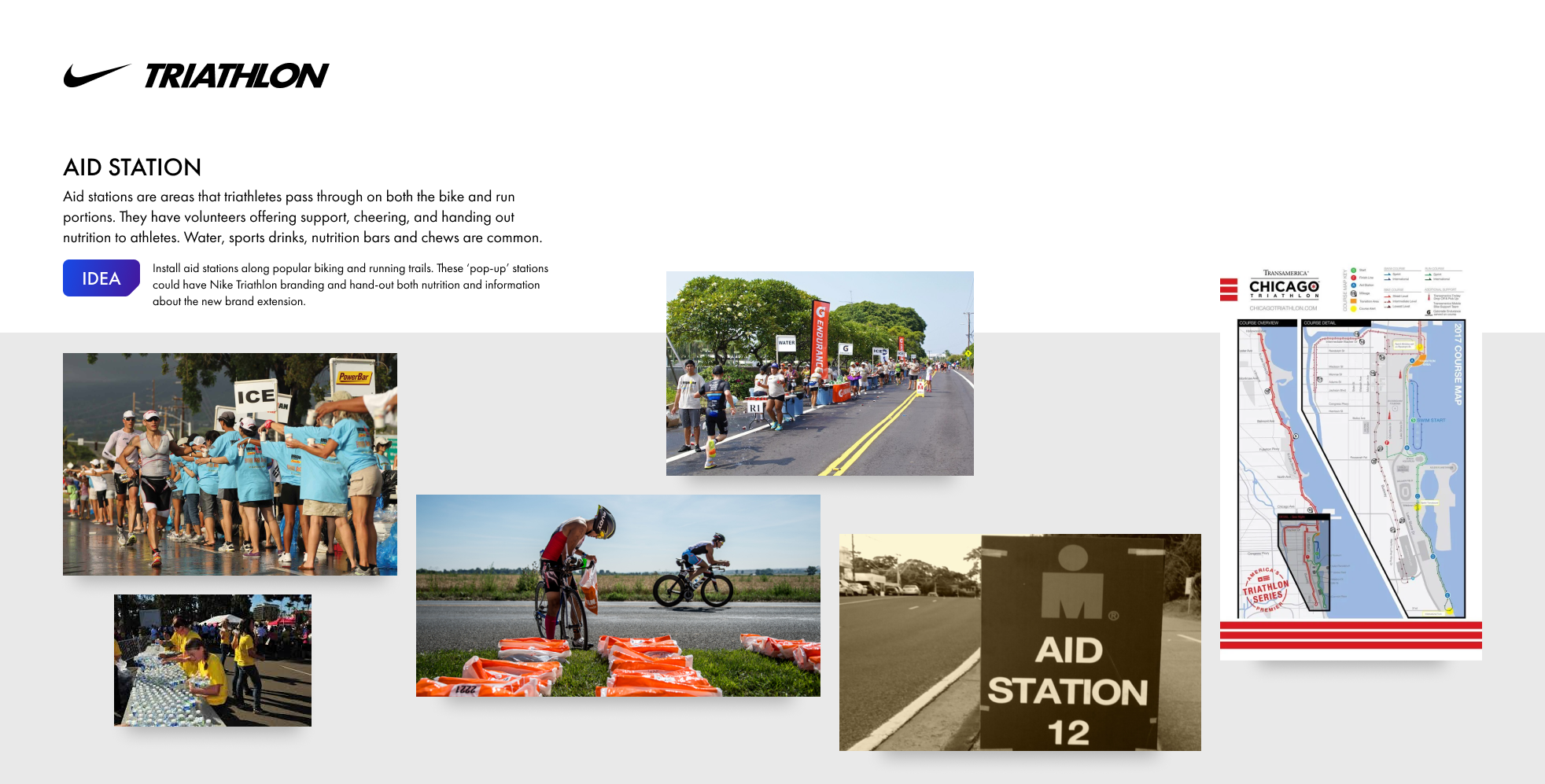
Aid stations. Similar to transition areas, aid stations are part of every triathlon. They have designated sections throughout the bike and run portions of the race where athletes can pick up food, hydration, and get cheered by volunteers. They are really fun parts of every triathlon and could be an excellent opportunity for Nike Triathlon to interact directly with consumers. I could see transitions set up on popular biking and running trails. Nike Triathlon workers would cheer everyone who passes by the aid station. They could hand out food and drink, and pass out small take-aways. There would be signage showing the distance to popular locations in the area.
package design
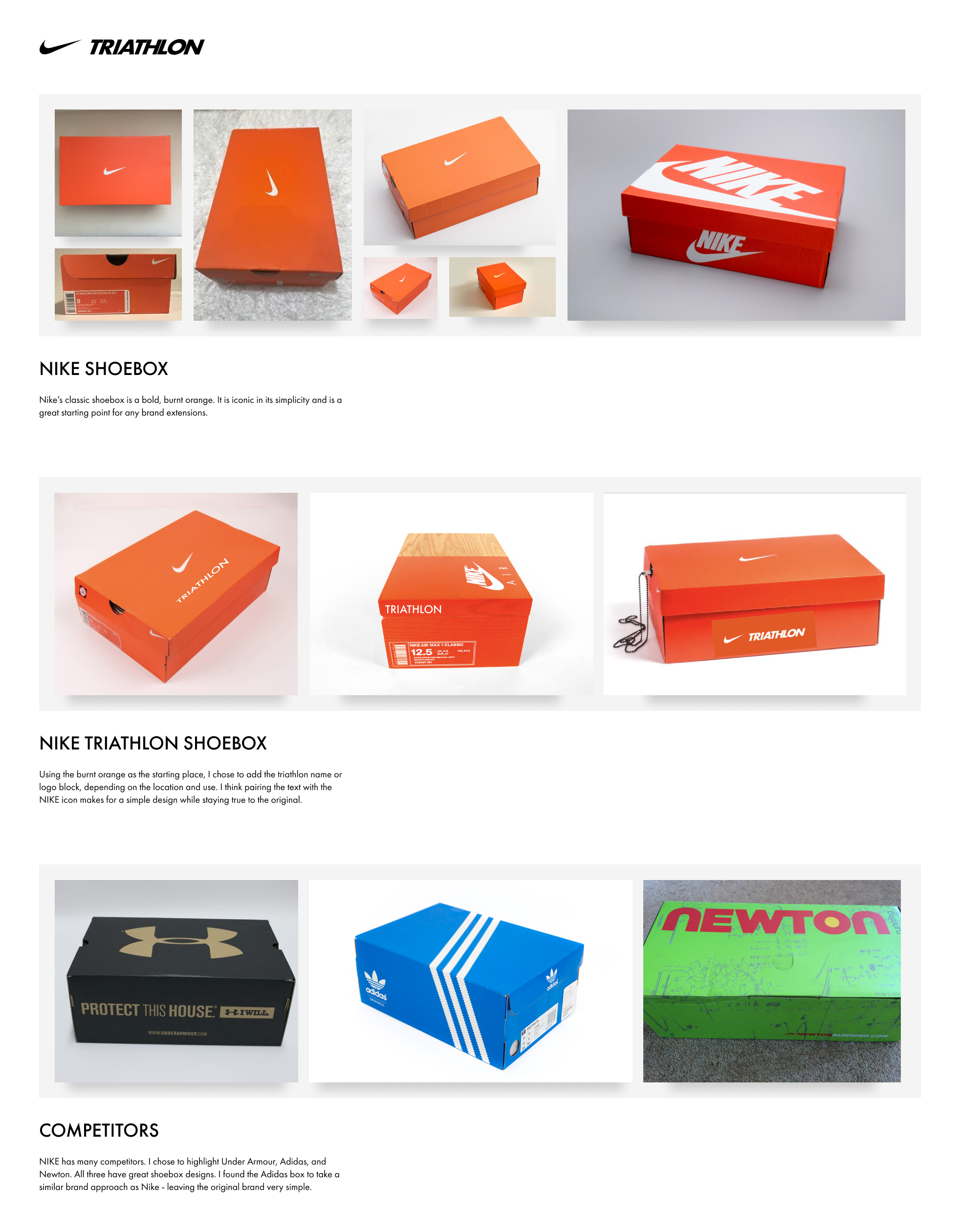
I chose to focus this assignment on exploring shoebox designs for NIKE TRIATHLON. After doing some research, I came across a burnt orange shoebox design Nike used (and still uses) for many different shoe markets. I explored what NIKE TRIATHLON might look like in a similar style, contrasting that with the Under Armour, Adidas, and Newton shoe brands.
global market
I chose to explore the idea of Nike Triathlon entering the European triathlon market. Europe is already home to many of the sports emerging race programs and circuits. Many brands jump on these race series to boost their exposure and reach a wider audience. I thought a similar approach for Nike would translate to even higher profits because of the brand awareness most triathletes have.
IRONMAN 70.3 & 140.6
Perhaps the largest global market for triathlon races is the IRONMAN 70.3 & 140.6 race series. These race series are the longest and most difficult triathlons available. They have a global following and draw athletes from all over the world. In recent years, there has been more of an effort to use them as a way to catapult emerging brands by offering them incredible availability and access to the athletes. For this reason, I think it would make an excellent opportunity for Nike Triathlon to sponsor either a 70.3 or 140.6 race event. This would get the attention of athletes already familiar with the Nike brand to take notice of the new brand extension.
Challenge: Develop a new message or visual approach for the brand or one of its products.
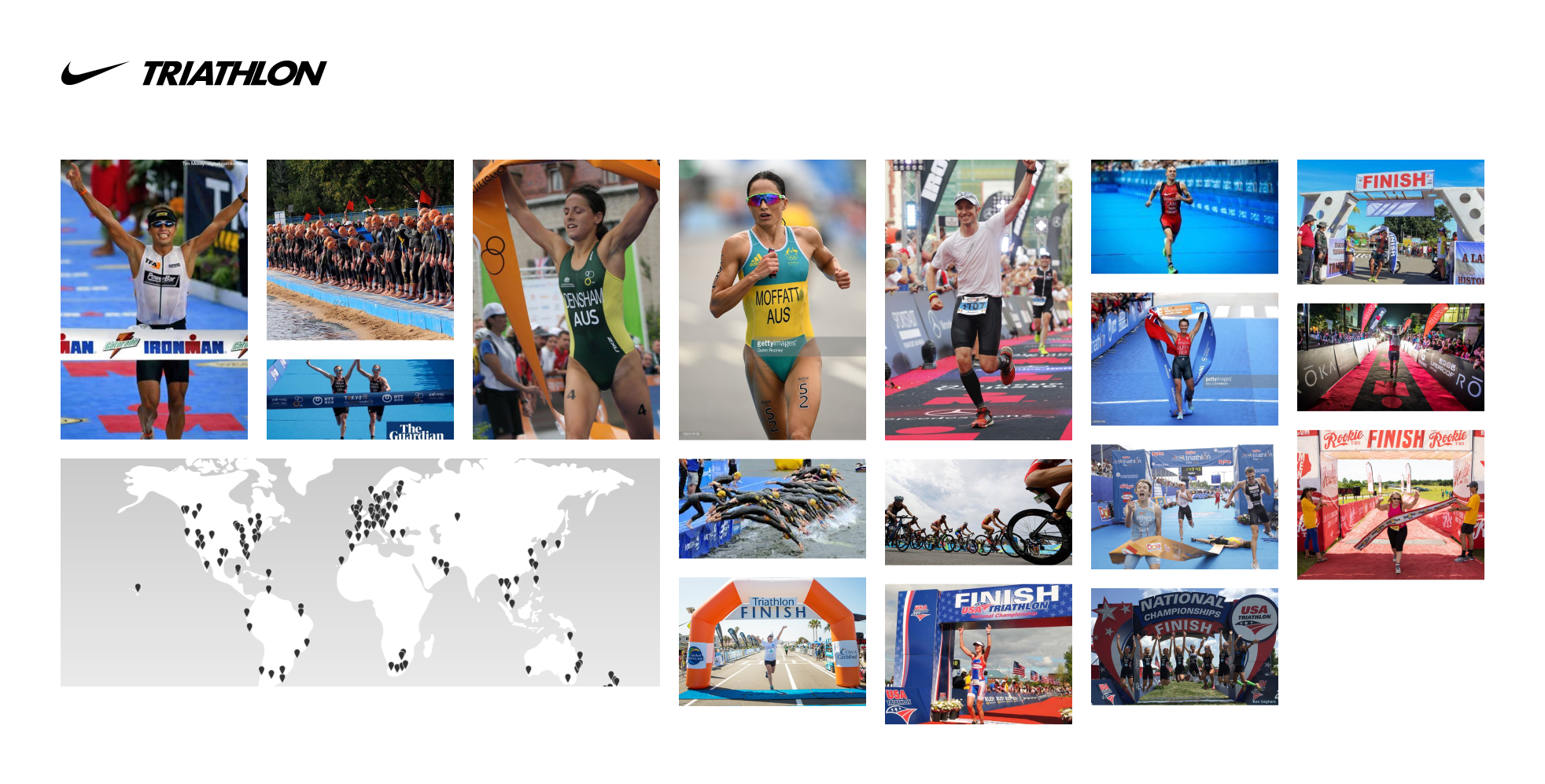
Triathlon Series
Put simply, Europe is more interested in triathlon than the US. By expanding to the EU, Nike Triathlon would be able to leverage its brand image with an already interested and passionate athlete base.
Cultural Differences
When considering what differences Nike Triathlon must consider in order to succeed internationally, one must understand the cultural differences outside of sport. The european market is much more complex than the US, where there are more languages, countries, and ways of life that differ from the more homogenous US market.
interface design
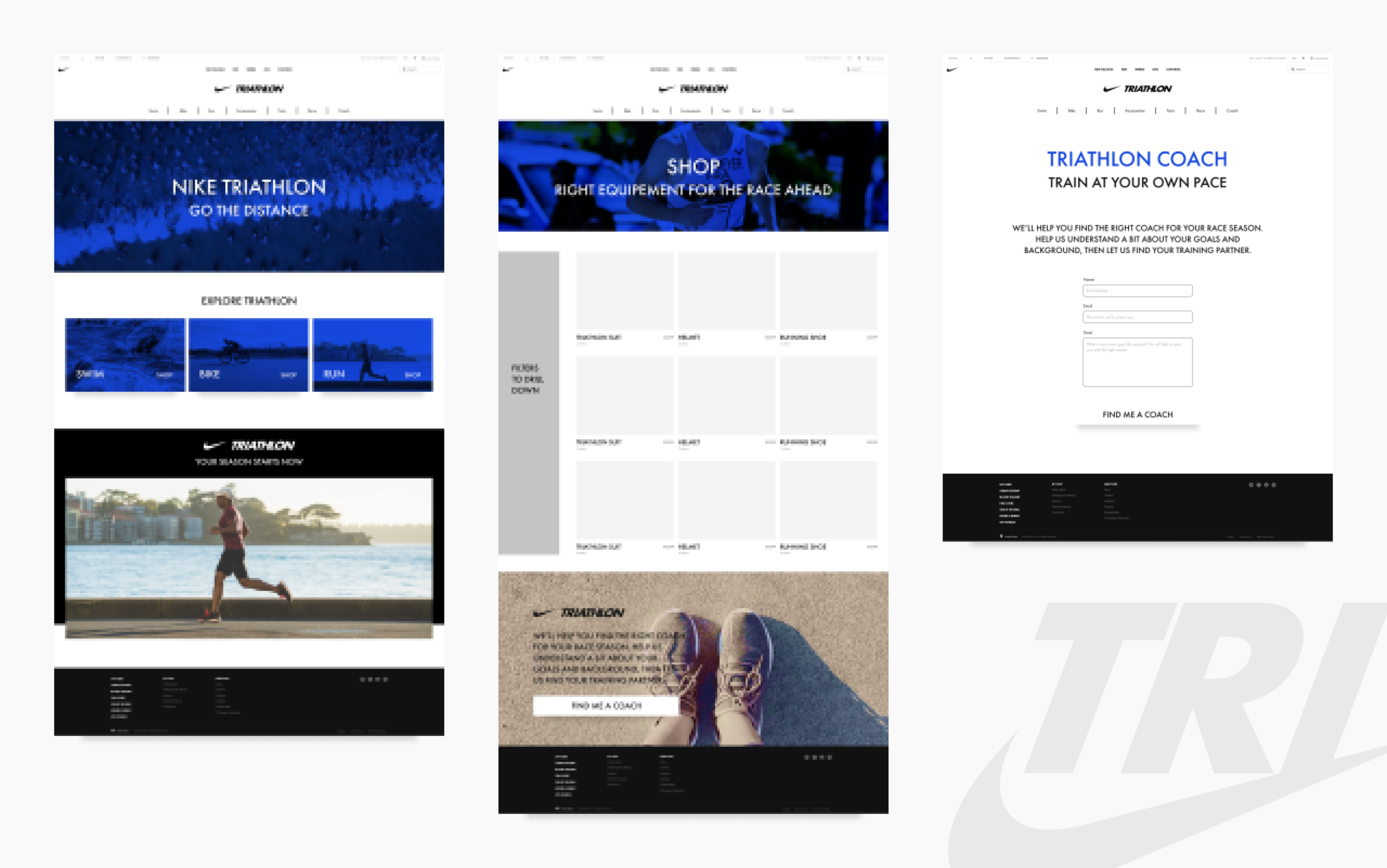
For this design workout, I chose to explore what a Nike Triathlon homepage, shop, and trainer web page could look like. Let me know what you think. The homepage would be the launching point for site visitors to shop, learn about the brand, find a coach, and more.
Challenge: Create UI mockups based on your client’s brand extension.
social media campaign
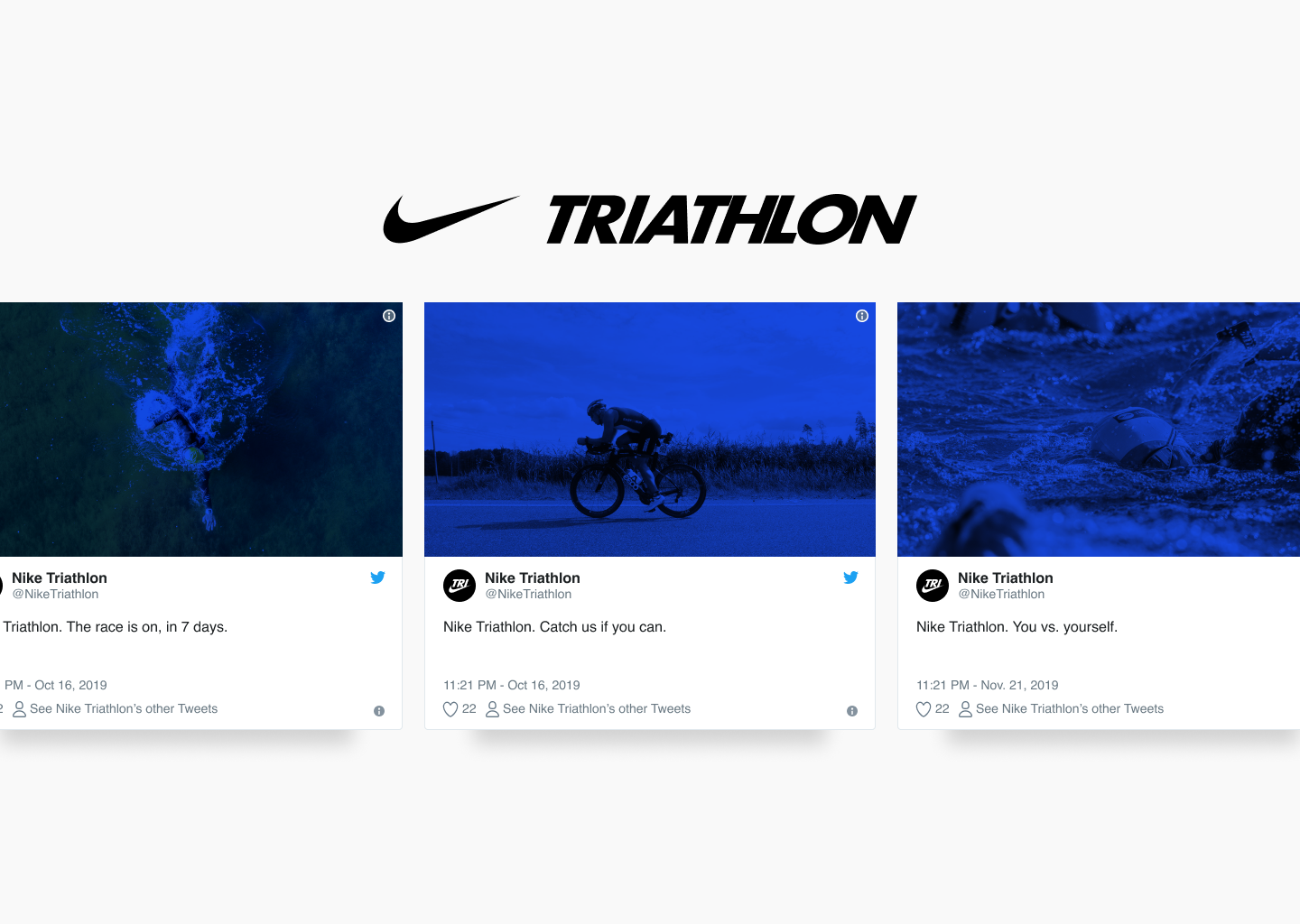
Here are three tweets for Nike Triathlon. I chose to explore the simple route for a few tweets that could be the first posts from a Nike Triathlon social media account. Once this took off and athletes began to get excited, I could see how it would make sense to explore other platforms. But to start, keep it simple and focus on a single one.